Two major photographers. Two months of September at the opposite. This book recounts the events that have shaped Chilean history. These events are seen through the lenses of two leading figures in photojournalism. In September 1971, Raymond Depardon set off for Santiago. He wanted to capture the effervescence that followed the election of socialist president Salvador Allende in 1970. He continued his journey in the south of the country. Two years later, in September 1973, David Burnett arrived in the Chilean capital shortly after the coup d’état. He photographed the moments of tension and terror that followed. This immersion in the Chile of the 1970s questions what the country has become today, fifty years after the events.
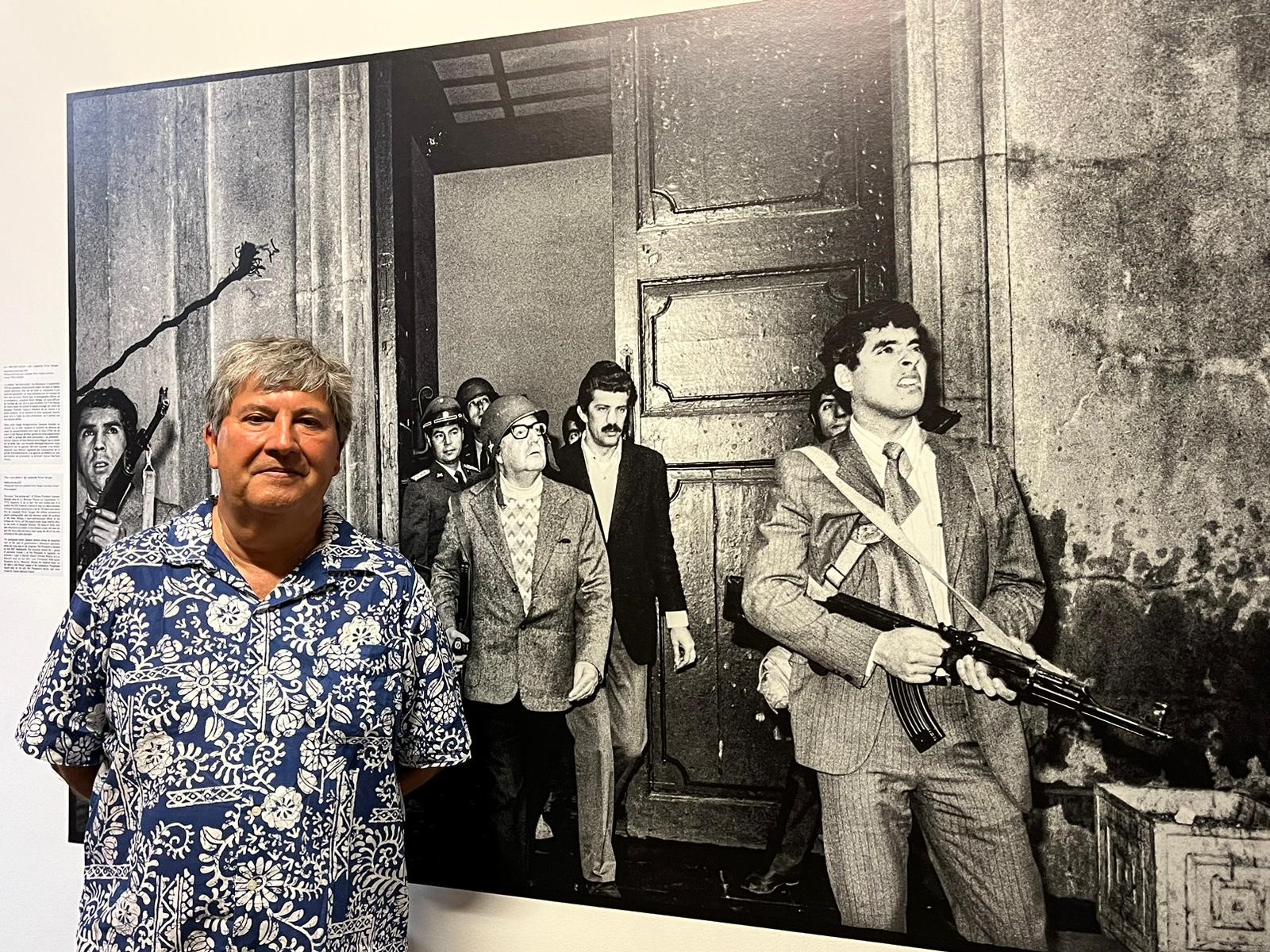
Alex Vargas Caroca poses next to a photograph made by his father, presidential photographer, Leopoldo Victor Vargas, at the gallery Le Château d’Eau, Toulouse, France. Monday, September 11, 2023. Credits: Leopoldo Vargas Family.
The “last photo” of Allende and its legend is the title of a report by Michel Guerrin, in the prestigious French newspaper Le Monde, from Sunday, September 10 to Monday, September 11, 2023. [1] After presenting and discussing some of the details and background of the photograph and of the presidential photographer, Leopoldo Vargas, in a full-page report, without advertisements, the report concludes:
Le photographe? Leopoldo Vargas, cet homme discret qui a probablement enregistré la « naissance » et la mort d’Allende– Le Monde.
Photographer Leopoldo [Víctor] Vargas is the discreet man who probably recorded Allende’s “birth” and death.
Why does it say that? Because presidential photographer Leopoldo Víctor Vargas made and preserved for posterity the two most important images of President Salvador Allende Gossens at La Moneda Palace, the seat of government in Chile. [2]
The first photograph is from November 3, 1970. On his first day as President of the Republic, after Allende was invested with the presidential sash in the National Congress, Leopoldo Vargas made the photograph that would be used as the Official Portrait of President Allende, in the Salón Rojo [Red Hall] of La Moneda. [3]
The second photograph corresponds to one he made on September 11, 1973, during the coup d’état. On that day, presidential photographer Leopoldo Vargas made six photos of Allende inside La Moneda. Among these, there is one that crushes the others to the point of being commonly called the“last photo of Allende”. It’s the iconic photograph that won the World Press Photo of the Year 1973 award in the Netherlands. [4]
In connection with the presentation of a new book, the French newspaper Le Monde interviewed the journalist, co-founder and president of the photo agency Contact Press Images:
Robert Pledge is the conductor of a fresh and moving book, Septembre au Chili, 1971/1973 (Atelier EXB, 192 p., 49 €), [5] in which he publishes and documents “the last photo of Allende”, along with two photo reportages: one by French photographer Raymond Depardon in 1971 in Allende’s Chile, and one by American photographer David Burnett in the wake of the putsch in September 1973. The famous photo embodies the transition from Allende’s Chile to Pinochet’s. (Le Monde)
The presentation of this book was held in conjunction with the opening of the exhibition of the photographs, Raymond Depardon – David Burnett, Septembre au Chili, 1971/1973, on Monday, September 11, 2023, at the gallery Le Chateau d’Eau, Toulouse, France. The exhibition was on display from September 11, 2023, until January 7, 2024.
The press visits and the opening of the exhibition to the public were attended by the artists; French photographer Raymond Depardon and American photographer David Burnett. On behalf of the late presidential photographer Leopoldo Victor Vargas two of his sons were also present- Leopoldo (Polo) and Alex Vargas Caroca. [6]
From left to right: French photographer Raymond Depardon, Leopoldo Vargas (son), and American photographer David Burnett, during the book signing session, at the Librairie Ombres Blanches, Toulouse, France. Tuesday, September 12, 2023. Credits: Leopoldo Vargas Family.
[2] At great personal risk, Leopoldo Víctor Vargas had the courage to save, and protect these priceless photographic and historical documents, from the indiscriminate policy of destruction, of any documentation related to the Popular Unity government, that the Military Junta carried out after September 11, 1973.
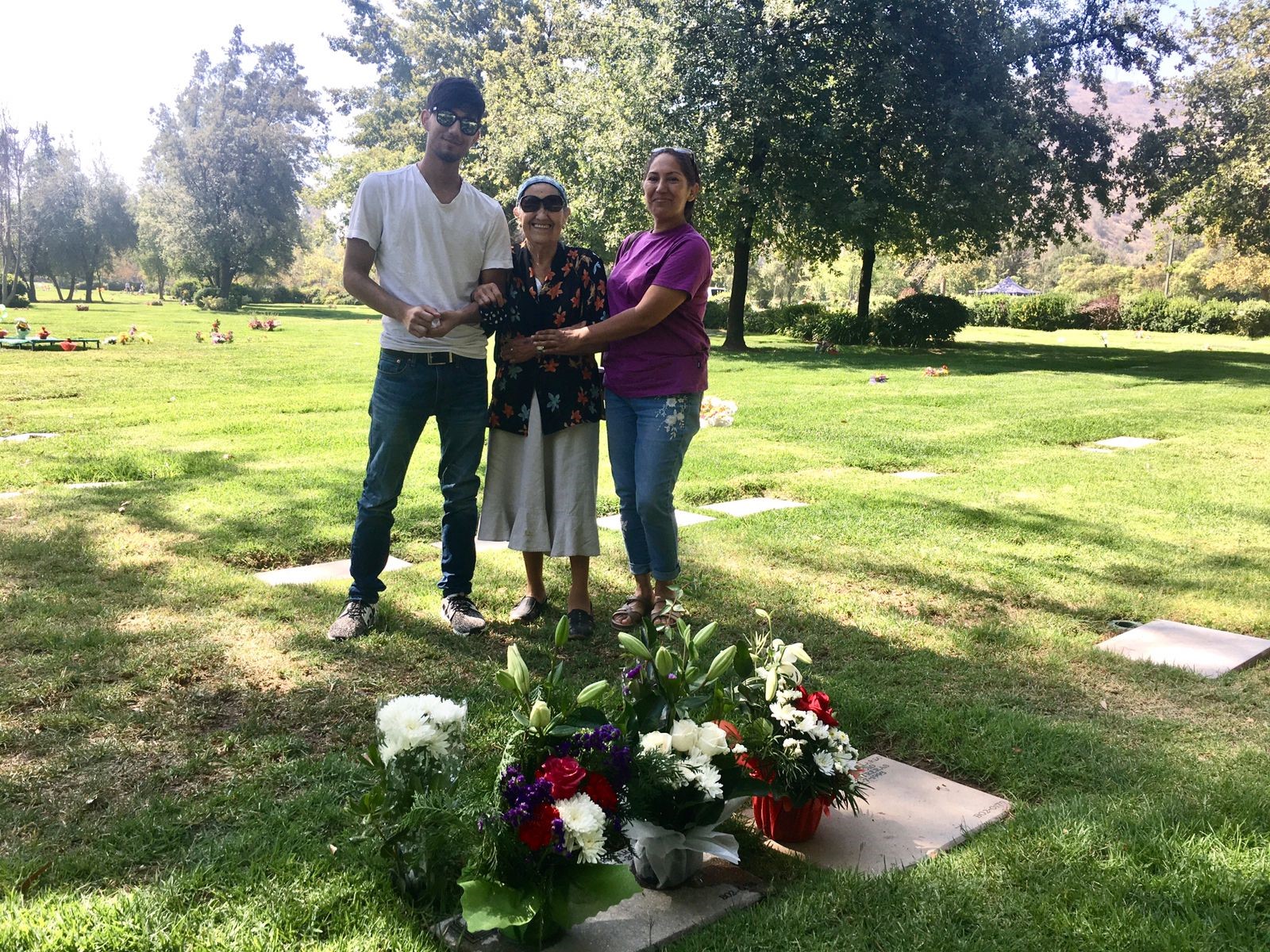
On the day of his memorial, visiting Leopoldo Vargas tomb, is his widow Erika Caroca Atenas, his daughter Erika Maria Vargas, and one of his grandsons, Miguel Salgueiro Vargas.
Twelve years ago, on the afternoon of Saturday 26th, 2011, Presidential Photographer and Chilean Air Force NCO (R) Leopoldo Víctor Vargas passed away in Santiago de Chile, at age 78.
As Presidential Photographer (between 1964-1973) at the Chilean seat of government, La Moneda Palace, he made the picture winner of the World Press Photo of the Year 1973. Leo Vargas also made the Presidential Official Portrait of late President Salvador Allende, at the very beginning of his presidency in 1970. Therefore, he is the author of the two most important pictures of Allende’s government.
And, after the 1973 Coup d’état, at the Diego Portales building, he shot the first official portrait of each one of the four members of the Military Junta– Army Gen. Augusto Pinochet, Admiral José Toribio Merino, Aviation Gen. Gustavo Leigh, and Carabineros Gen. César Mendoza.
One of his pictures is considered one of the 100 most influential images of all time, and counted among the photos that changed the world. Also, it’s acknowledged as a universal icon of photography.
But above of all of his life achievements, he was a humble God-fearing man, a dear husband, father, and grandfather. Today we commemorate his death.
His widow, and family members, with deep love and respect, look forward to seeing him again on the fast-approaching day of resurrection. We all missed him very much. Agape.




 World Press Photo 1973