Two major photographers. Two months of September at the opposite. This book recounts the events that have shaped Chilean history. These events are seen through the lenses of two leading figures in photojournalism. In September 1971, Raymond Depardon set off for Santiago. He wanted to capture the effervescence that followed the election of socialist president Salvador Allende in 1970. He continued his journey in the south of the country. Two years later, in September 1973, David Burnett arrived in the Chilean capital shortly after the coup d’état. He photographed the moments of tension and terror that followed. This immersion in the Chile of the 1970s questions what the country has become today, fifty years after the events.
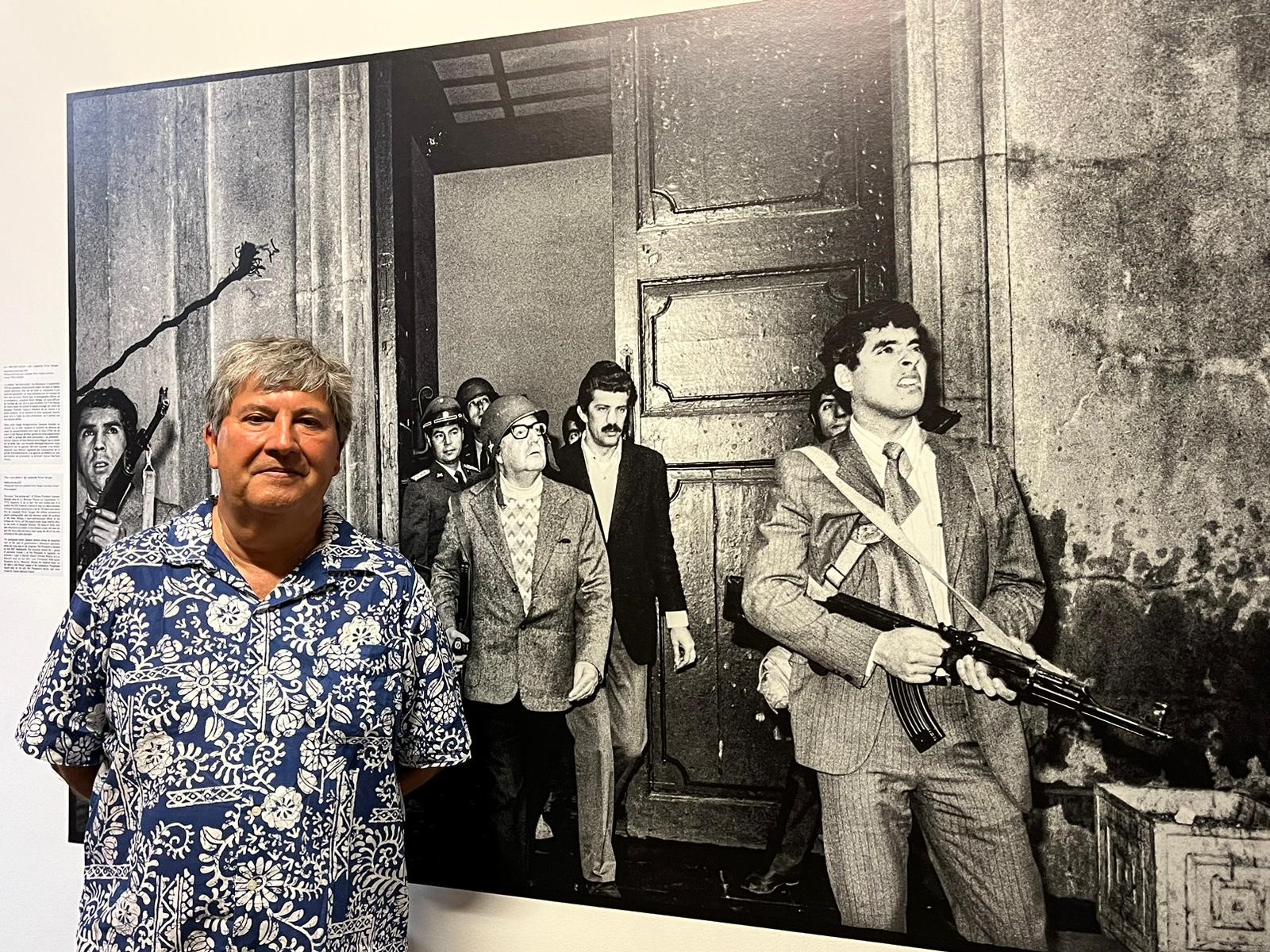
Alex Vargas Caroca poses next to a photograph made by his father, presidential photographer, Leopoldo Victor Vargas, at the gallery Le Château d’Eau, Toulouse, France. Monday, September 11, 2023. Credits: Leopoldo Vargas Family.
The “last photo” of Allende and its legend is the title of a report by Michel Guerrin, in the prestigious French newspaper Le Monde, from Sunday, September 10 to Monday, September 11, 2023. [1] After presenting and discussing some of the details and background of the photograph and of the presidential photographer, Leopoldo Vargas, in a full-page report, without advertisements, the report concludes:
Le photographe? Leopoldo Vargas, cet homme discret qui a probablement enregistré la « naissance » et la mort d’Allende– Le Monde.
Photographer Leopoldo [Víctor] Vargas is the discreet man who probably recorded Allende’s “birth” and death.
Why does it say that? Because presidential photographer Leopoldo Víctor Vargas made and preserved for posterity the two most important images of President Salvador Allende Gossens at La Moneda Palace, the seat of government in Chile. [2]
The first photograph is from November 3, 1970. On his first day as President of the Republic, after Allende was invested with the presidential sash in the National Congress, Leopoldo Vargas made the photograph that would be used as the Official Portrait of President Allende, in the Salón Rojo [Red Hall] of La Moneda. [3]
The second photograph corresponds to one he made on September 11, 1973, during the coup d’état. On that day, presidential photographer Leopoldo Vargas made six photos of Allende inside La Moneda. Among these, there is one that crushes the others to the point of being commonly called the“last photo of Allende”. It’s the iconic photograph that won the World Press Photo of the Year 1973 award in the Netherlands. [4]
In connection with the presentation of a new book, the French newspaper Le Monde interviewed the journalist, co-founder and president of the photo agency Contact Press Images:
Robert Pledge is the conductor of a fresh and moving book, Septembre au Chili, 1971/1973 (Atelier EXB, 192 p., 49 €), [5] in which he publishes and documents “the last photo of Allende”, along with two photo reportages: one by French photographer Raymond Depardon in 1971 in Allende’s Chile, and one by American photographer David Burnett in the wake of the putsch in September 1973. The famous photo embodies the transition from Allende’s Chile to Pinochet’s. (Le Monde)
The presentation of this book was held in conjunction with the opening of the exhibition of the photographs, Raymond Depardon – David Burnett, Septembre au Chili, 1971/1973, on Monday, September 11, 2023, at the gallery Le Chateau d’Eau, Toulouse, France. The exhibition was on display from September 11, 2023, until January 7, 2024.
The press visits and the opening of the exhibition to the public were attended by the artists; French photographer Raymond Depardon and American photographer David Burnett. On behalf of the late presidential photographer Leopoldo Victor Vargas two of his sons were also present- Leopoldo (Polo) and Alex Vargas Caroca. [6]
From left to right: French photographer Raymond Depardon, Leopoldo Vargas (son), and American photographer David Burnett, during the book signing session, at the Librairie Ombres Blanches, Toulouse, France. Tuesday, September 12, 2023. Credits: Leopoldo Vargas Family.
[2] At great personal risk, Leopoldo Víctor Vargas had the courage to save, and protect these priceless photographic and historical documents, from the indiscriminate policy of destruction, of any documentation related to the Popular Unity government, that the Military Junta carried out after September 11, 1973.
Opening of the World Press Photo Exhibition 1974. The Van Gogh Museum, Amsterdam, Netherlands, March 29th, 1974.
This newsreel features the prize awarding ceremony of the World Press Photo 1973 contest.
The World Press Photo Exhibition of 1974 was held at the Van Gogh Museum in Amsterdam. The event highlighted the most impactful images captured by photographers from around the globe. The exhibition not only celebrated the art of photography but also highlighted the profound stories behind each image.
One of the most poignant moments of the ceremony was when Prince Bernhard of the Netherlands presented the “Golden Eye“, for World Press Photo of the Year 1973, to Dane N. Bath, picture editor of The New York Times and Time Life representant, for “the last photo of President Salvador Allende” of Chile, made by an Anonymous photographer. The winning photograph depicted the last moments of President Salvador Allende of Chile.
Chilean Presidential Photographer (1964-1973) and Chilean Air Force NCO (R) Leopoldo Victor Vargas could not reveal his authorship for safety reasons.
The grand prize winner picture was unanimously chosen from among 3.532 photos of 603 participating photographers, from 38 countries, reflecting the diverse and powerful perspectives that photojournalism brings to the world stage. The winners were announced on March 27, 1974, see The New York Times, Thursday, March 28, 1974, p. 8.
The World Press Photo of the Year is a testament to the courage and dedication of photographers who often risk their lives to document the truth. Their work serves as a visual record of history, capturing moments that can influence public opinion and policy. The 1974 exhibition, therefore, was not just a display of artistic talent but a reminder of the significant role that visual storytelling plays in our understanding of global events and human experiences. The legacy of these photographs continues to inspire and challenge viewers, encouraging a deeper engagement with the world around us.
Credits: Uploaded on May 4th 2009 by Nederlands Instituut voo Beeld en Geluid.
Last Monday 26th, January 2015, was the 41st anniversary of the publication, in the American newspaper The New York Times, of the picture of the only Chilean photographer winner of the prestigious prize World Press Photo of the Year 1973, awarded by the World Press Photo Foundation in the Netherlands. It is the world’s most important prize in Photojournalism. The image shows one of the last photos of Chilean President Dr. Salvador Guillermo Allende Gossens alive, wearing a helmet and rifle on his shoulder, inside the Chilean Palace of Government, La Moneda, the day of the Coup d’état, on September 11, 1973. It was taken that fateful morning at about 09:40 a.m. by Leopoldo Víctor Vargas– presidential photographer and non-commission officer (NCO) of the Chilean Air Force. [1] Since it’s publication in The New York Times this picture has become a truly world photo icon.
The World Press Photo of the Year 1973 depicts Chilean President, Dr. Salvador Allende, during his tour of inspection through La Moneda Palaceof government, looking for the best positions for its defense, while the Coup is in progress. Allende is flanked by two members of his personal guard, known by the acronym GAP, which in Spanish stands for “Group of Personal Friends” of the President. On Allende’s far right is Héctor Daniel Urrutia Molina (a.k.a. Miguel) and to the far left side is, the tallest one, squinting, Luis Fernando Rodríguez Riquelme (a.k.a. Mauricio). Right behind the President is José Muñoz, Captain of the Carabineros Presidential Guard, and Allende’s friend Dr.Danilo Bartulín Fovich.




 World Press Photo 1973